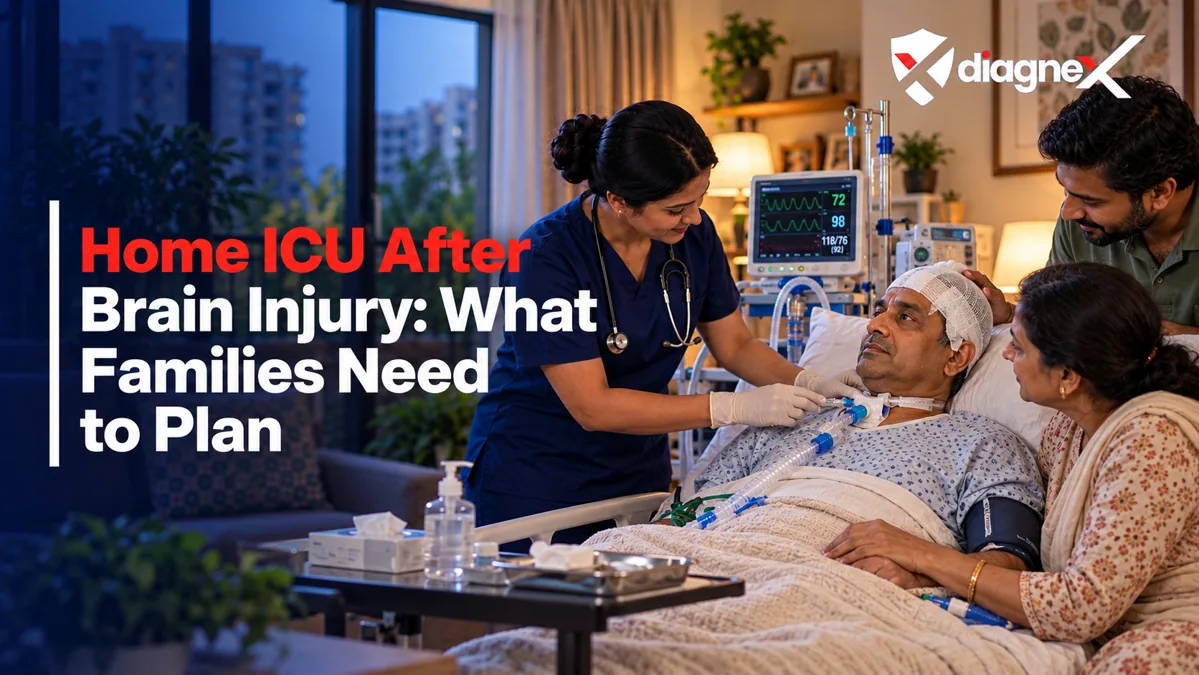
A home ICU after brain injury is not appropriate for a patient who is still neurologically unstable or needs emergency imaging, neurosurgery, intracranial-pressure management or rapid changes in treatment. New loss of consciousness, worsening responsiveness, repeated vomiting, new weakness, unequal pupils, seizure activity or sudden breathing problems require urgent hospital assessment.
For related context, read Home ICU After Cardiac Surgery: What to Plan and Power Backup for Home ICU: What Families Need to Plan.
For related context, read Home ICU After Cardiac Surgery: What to Plan and Power Backup for Home ICU: What Families Need to Plan.
Home ICU or high-dependency care may be considered only after the treating team has decided that the patient is stable enough to leave hospital and that the remaining medical, nursing and rehabilitation needs can be managed safely at home. Depending on the injury, these needs may include airway care, tracheostomy support, oxygen, suction, tube feeding, seizure precautions, pressure-area care, catheter care, neurological observation and rehabilitation.
The Centers for Disease Control and Prevention notes that people recovering from moderate or severe traumatic brain injury may need specialized medical and rehabilitation care, and that recovery varies according to the severity of injury, access to care and family support. The home plan therefore needs to be individualized rather than based on a standard equipment package.
Acute or Worsening Brain Injury Belongs in Hospital
The first priority is to separate post-acute home care from emergency neurocritical care.
A patient with deteriorating consciousness, a new focal neurological deficit, repeated seizures, uncontrolled vomiting, severe new headache, rapidly changing pupils or worsening breathing may need urgent imaging, intensive monitoring or neurosurgical treatment that cannot be safely reproduced at home.
Families should never delay hospital transfer because a home ICU has already been set up.
Who May Be Considered for Home ICU After Brain Injury?
Some patients remain medically complex after the acute phase even though they no longer need continuous hospital diagnostics or emergency intervention.
Examples may include a medically stable person who still needs tracheostomy care, prescribed oxygen, suction, tube feeding, frequent repositioning, pressure-area care, catheter care, seizure precautions or close nursing observation.
Who Is Suitable for ICU Care at Home? explains why stability, predictability and the ability to deliver the required care safely matter more than diagnosis alone.
Treating-Team Approval Should Come Before Equipment
The decision to move home should come from the hospital and treating specialists.
The discharge plan should describe the diagnosis, current neurological state, airway and breathing needs, feeding route, medicines, monitoring requirements, seizure history, rehabilitation plan, follow-up and emergency escalation criteria.
Families should not purchase equipment first and then assume the presence of a monitor, oxygen source or hospital bed makes home care clinically suitable.
Home ICU Is Not the Same as a Neuro ICU
A hospital neuro ICU has immediate access to neurologists, neurosurgeons, emergency imaging, laboratory testing, invasive monitoring, procedures and resuscitation.
A home ICU can support selected stable patients with planned equipment, nursing and physician follow-up, but it cannot reproduce every hospital capability.
Is ICU at Home Safe? What Needs to Be in Place explains why safety depends on staffing, monitoring, backup systems, escalation and patient selection rather than equipment alone.
Neurological Observation Must Be Defined
Brain injury care often requires observation of alertness, responsiveness, pupil changes, movement, speech or communication, behaviour and seizures.
The treating team should specify what the home nurse is expected to observe and how often. Families should know what counts as a meaningful change for that patient.
A numerical monitor cannot replace clinical observation because many neurological deteriorations first appear as changes in behaviour, movement or consciousness.
Changes in Consciousness Need Careful Interpretation
Some patients with severe acquired brain injury have prolonged disorders of consciousness.
The American Academy of Neurology guideline for disorders of consciousness, reaffirmed in 2024, recommends specialized assessment and repeated evaluation because diagnosis and recovery can change over time.
If the patient has a disorder of consciousness, the home plan should include follow-up with clinicians experienced in brain-injury rehabilitation rather than assuming the level of responsiveness will remain fixed.
Watch for Red Flags of Neurological Deterioration
Urgent reassessment may be needed for a sudden drop in responsiveness, new weakness, repeated vomiting, a new severe headache, new abnormal posturing, new or repeated seizures, unequal pupils or a major change in breathing pattern. For more on the practical service arrangements, review home nursing before deciding what information the care team needs.
These changes may indicate a complication that requires hospital imaging or intervention.
The home team should follow the written escalation plan rather than observing a major deterioration for several hours to see whether it settles.
Airway and Breathing Support May Be Required
Some patients return home with a tracheostomy, prescribed oxygen, suction needs or other respiratory support.
The exact setup should follow the treating team's respiratory plan. Nurses and caregivers must be trained for the specific equipment in use, and emergency backup should be available when the patient depends on powered devices or oxygen.
The Home ICU service pathway describes how monitoring, nursing and breathing support are planned around the individual patient's needs.
Tracheostomy Care Requires Competent Staff
A patient with a tracheostomy may need suction, humidification, stoma care, tube security, secretion management and emergency procedures.
The nurse should be competent in the tracheostomy device and the patient's prescribed airway plan. Backup supplies and emergency equipment should be readily accessible.
Increasing breathing difficulty, inability to clear secretions, suspected tube displacement, cyanosis or rapidly falling oxygen saturation requires urgent escalation.
Swallowing Problems Can Persist After Brain Injury
Brain injury can affect swallowing, alertness and the ability to protect the airway.
A patient who has not been cleared for oral food, fluids or medicines should not be given them simply because they appear more awake or ask for water. The feeding route and texture plan should follow the swallowing assessment.
New coughing during feeding, repeated choking, a wet or gurgly voice, fever or new breathing difficulty should be reported promptly.
Tube Feeding Needs a Written Plan
Some patients require nasogastric or gastrostomy feeding during recovery.
The home plan should specify the prescribed feed, volume, water, medicine administration, positioning, tube care and what to do if the tube is blocked, displaced or accidentally removed.
Families should not improvise replacement or use unapproved methods to clear a tube.
Nutrition and Hydration Still Need Review
A patient can receive tube feeding and still develop nutrition or hydration problems.
Weight trends, feed tolerance, bowel pattern, urine output, vomiting, diarrhoea and hydration status should be reviewed according to the clinical plan.
Reduced intake, persistent vomiting, abdominal swelling or increasing drowsiness should not be assumed to be part of the brain injury without assessment.
Seizure Risk Needs a Specific Emergency Plan
Seizures can occur after traumatic brain injury.
The Model Systems Knowledge Translation Center notes that post-traumatic seizures may occur soon after injury or later, and caregivers should know how to keep the person safe and document what happened.
If the patient has a known seizure disorder, the home plan should state prescribed medicines, rescue treatment if any, what caregivers should do during a seizure and when emergency services should be called.
A New or Prolonged Seizure Needs Urgent Escalation
A first seizure after discharge, repeated seizures without recovery, a seizure that lasts longer than the patient's emergency plan allows, significant injury or breathing difficulty requires urgent medical help.
Caregivers should not put objects in the person's mouth or try to restrain convulsive movements.
The patient should be protected from injury and positioned according to the emergency plan when it is safe to do so.
Craniectomy Precautions Must Follow Neurosurgical Advice
Some patients have a skull defect after decompressive craniectomy.
The neurosurgical team should provide explicit instructions about protecting the surgical area, sleep and positioning precautions, helmet use when prescribed, wound care and follow-up for later cranioplasty.
Family members should not apply pressure over an unprotected skull defect or invent helmet or positioning rules without the neurosurgical plan.
Blood Pressure, Pulse, Temperature and Oxygen May Need Monitoring
Vital-sign monitoring should match the patient's diagnosis and discharge instructions.
The treating team should define which observations matter, how often they should be checked and which changes require a call or transfer.
Families should not adopt generic oxygen or blood-pressure targets from another patient's care plan.
Pressure-Injury Prevention Is Essential for Immobile Patients
Patients with severe brain injury may be unable to reposition themselves.
A pressure-relieving mattress, regular skin inspection, repositioning, moisture control and adequate nutrition may be part of the home-care plan. The exact repositioning schedule should be individualized.
Bedridden Patient Care at Home may become relevant when the patient needs substantial daily support with hygiene, positioning and pressure-area prevention.
Spasticity and Abnormal Posturing Need Rehabilitation Input
Brain injury can lead to muscle stiffness, spasticity, contractures or abnormal postures.
Positioning, stretching, splinting and movement programmes should follow professional assessment because aggressive stretching or poor handling can cause pain or injury.
Rehabilitation at Home may be relevant when the patient needs coordinated support for mobility, positioning, function and longer-term neurological recovery.
Safe Handling Protects Weak or Spastic Limbs
Caregivers should be taught how to turn, transfer and position the patient without pulling on a weak arm or forcing a stiff joint.
The technique may differ according to consciousness, muscle tone, fractures, surgical precautions and weight-bearing status.
Two-person assistance or mechanical equipment may be needed when a single caregiver cannot move the patient safely. If the family is considering support at home, the Diagnex guide to medical equipment on rent explains the service pathway and its limits.
Physiotherapy Should Match Medical Stability
Rehabilitation after moderate or severe brain injury may include physiotherapy to improve bed mobility, sitting, transfers, balance, strength and walking when appropriate.
The CDC notes that rehabilitation can help people with moderate or severe traumatic brain injury improve daily function and quality of life.
Physiotherapy at Home may be relevant when the treating team considers the patient medically stable enough for home-based mobility and rehabilitation work.
Cognitive and Communication Problems May Affect Care
Brain injury can affect memory, attention, judgment, language, behaviour and insight.
A patient who appears physically stronger may still require close supervision because they do not recognise hazards or cannot follow safety instructions reliably.
The care plan may need speech-language therapy, occupational therapy, neuropsychology or rehabilitation-medicine follow-up depending on the deficits present.
Agitation and Behaviour Change Need a Clinical Approach
Agitation after brain injury can be caused by pain, overstimulation, sleep disruption, infection, medication effects, confusion or neurological recovery.
The environment should be calm and predictable, but severe or sudden behavioural change should be reviewed medically.
Physical restraint should not be used casually at home because it can create injury, distress and additional medical risk.
Home ICU Nursing Requires Defined Competencies
The nurse assigned to a brain-injury home ICU should be competent for the procedures the patient actually needs.
These may include neurological observations, airway care, suction, tracheostomy care, oxygen, tube feeding, catheter care, wound or pressure-area management, medicines and clinical documentation.
Home Nursing may be relevant when the patient needs defined skilled nursing procedures in addition to general supervision.
Medication Management Must Be Organized
Brain-injury discharge medicines may include antiseizure drugs, pain medicines, anticoagulants, bowel medicines, antibiotics or other prescribed treatment.
A single current medication chart should be available to all nurses and caregivers. The team should know which medicines can be given through a feeding tube and which must not be crushed.
Dose changes, sedation concerns and seizure-medication adjustments remain with the treating clinician.
Catheter, Bowel and Bladder Care May Be Needed
Reduced mobility and neurological injury can affect bladder and bowel function.
If a urinary catheter is present, the home team should follow the prescribed catheter-care plan and monitor for blocked drainage, fever, lower abdominal pain or significant blood in the urine.
Constipation also deserves attention because immobility, dehydration and medicines can make it more likely.
Infection Prevention Remains Important at Home
A home is not a hospital isolation room, but structured infection prevention still matters.
Hand hygiene, clean handling of tracheostomy and feeding equipment, appropriate catheter care, safe waste disposal and regular cleaning of high-touch surfaces should be part of the routine.
Fever, new secretions, wound drainage, worsening oxygen needs or sudden change in alertness should be reported promptly.
The Home ICU Setup Must Be Patient-Specific
There is no single equipment list for every brain-injury patient.
Depending on the care plan, equipment may include a hospital bed, pressure-relief mattress, pulse oximeter, multiparameter monitor, oxygen source, suction machine, feeding pump, infusion or syringe pump, wheelchair, commode, hoist or mobility aids.
Equipment should be chosen after the clinical and home assessment, not from a generic checklist.
Power and Oxygen Backup Need to Be Planned
Any patient who depends on powered respiratory or feeding equipment needs a realistic failure plan.
Families should know how long battery backup lasts, how backup oxygen is accessed and whom to call if equipment fails.
A home ICU is not safe if essential equipment depends on one power source with no backup route.
Caregiver Training Should Happen Before Discharge
The CDC and brain-injury rehabilitation resources emphasize the importance of family education and rehabilitation support during recovery.
Before discharge, family members should understand which tasks they are expected to perform, which tasks remain nursing responsibilities and what changes require escalation.
Hospital ICU to Home: How the Transition Is Planned explains why caregiver training, equipment readiness and handover should be completed before the patient leaves hospital.
Patients With Disorders of Consciousness Need Specialist Follow-Up
A patient who remains minimally conscious or has another prolonged disorder of consciousness needs ongoing specialist assessment.
The American Academy of Neurology guideline states that such patients need specialized care and repeated evaluation because diagnosis and prognosis can evolve. For care planning beyond this article, compare bedridden patient care at home with the instructions already given by the treating professional.
Home care should therefore include scheduled neurological or rehabilitation follow-up rather than only custodial nursing.
The Family Needs a Written Emergency Escalation Plan
The plan should identify who to call, which hospital will receive the patient, how transport will be arranged and which records should travel with the patient.
It should also define the neurological, respiratory, seizure and equipment-failure triggers that require immediate transfer.
The emergency plan should be visible to all regular and relief caregivers.
When Should a Brain-Injury Patient Be Sent Back to Hospital?
Urgent hospital assessment is needed for: • a sudden drop in consciousness or inability to wake normally; • new weakness, unequal pupils or major change in speech or movement; • repeated vomiting or severe new headache; • a new or prolonged seizure or repeated seizures without recovery; • severe breathing difficulty, cyanosis or rapidly increasing oxygen requirement; • suspected tracheostomy displacement or inability to clear the airway; • uncontrolled bleeding; • persistent vomiting with inability to take essential medicines or feeds; • rapidly worsening fever, shock-like symptoms or major clinical deterioration.
The patient-specific discharge plan may contain additional triggers that should be followed.
When Home ICU May No Longer Be Appropriate
Home care may no longer be sufficient when the patient becomes unstable, needs repeated emergency imaging, develops escalating respiratory support needs, has uncontrolled seizures or requires interventions that cannot be delivered safely at home.
The setting should also be reassessed if staffing, equipment, backup power or emergency transport can no longer support the patient's dependency.
Moving back to hospital when needs increase is a safety decision, not a failure of home care.
A Practical Home ICU Checklist After Brain Injury
Before discharge, families can confirm: • The treating team has agreed that home care is clinically appropriate. • Current neurological status and expected observations are documented. • Airway, oxygen, suction and tracheostomy requirements are clear. • Seizure medicines and the seizure emergency plan are documented. • Feeding route, swallowing precautions and nutrition plan are written down. • Medicines and administration responsibilities are organized. • Pressure-area prevention and repositioning are planned. • Craniectomy or surgical precautions are documented when relevant. • Catheter, bowel and wound care are defined when needed. • Physiotherapy and rehabilitation plans are coordinated. • Required equipment has been installed and tested. • Backup power and oxygen are available when essential. • Nursing competencies and shift coverage are confirmed. • Emergency contacts and hospital-transfer arrangements are written down. • Family caregivers know which changes require immediate escalation.
How to Arrange Home ICU After Brain Injury With Diagnex
To plan home ICU after brain injury, share the hospital discharge plan, current level of consciousness, airway or tracheostomy needs, oxygen requirements, feeding method, seizure history, mobility, nursing procedures, equipment requirements, medicines, rehabilitation needs and locality.
Diagnex can review whether the requirement fits Home ICU, Home Nursing, Rehabilitation at Home, Physiotherapy at Home or another care pathway based on the treating team's plan and the patient's current stability. Exact staffing, equipment and service availability are confirmed for the specific locality and clinical requirement.
For service coordination, use the Diagnex Contact page.
Frequently asked questions
Can an unstable brain-injury patient be managed in a home ICU?
No. A patient who needs emergency imaging, neurosurgery, invasive neurocritical monitoring or rapid escalation should remain in hospital.
When can a brain-injury patient move from hospital to home ICU?
Only when the treating team considers the patient stable enough for care outside hospital and the required nursing, airway, feeding, monitoring, rehabilitation and emergency-transfer systems can be provided safely at home.
Can a patient with a tracheostomy be cared for at home?
Selected stable patients can be cared for at home when trained staff, suction, prescribed respiratory support, backup equipment and a clear emergency plan are in place.
What should families do about seizure risk after brain injury?
Follow the prescribed antiseizure medicine plan, keep a written emergency protocol, train caregivers in seizure first aid and seek urgent help for new, prolonged or repeated seizures according to the treating team's instructions.
Does every brain-injury patient need a monitor at home?
No. Monitoring should be chosen according to the patient's diagnosis, current stability and discharge plan. There is no single home ICU equipment package for all brain-injury patients.
Is rehabilitation possible while a patient is receiving home ICU care?
Yes, when the patient is medically stable enough. Physiotherapy and other rehabilitation can be coordinated with the nursing and neurological plan.
When should a brain-injury patient in home ICU return to hospital?
A sudden fall in consciousness, new neurological deficit, repeated vomiting, new or prolonged seizure, severe breathing problem, airway emergency or other major deterioration should trigger urgent hospital escalation according to the care plan.
References and further reading
This article provides general education and does not replace a neurologist, neurosurgeon, rehabilitation physician or hospital discharge plan. Clinical points were cross-checked against current CDC guidance on recovery after moderate or severe traumatic brain injury, Brain Trauma Foundation severe-TBI guidelines for acute neurocritical care, American Academy of Neurology guidance on prolonged disorders of consciousness, and Model Systems Knowledge Translation Center guidance on seizures and family care after traumatic brain injury.
Related Diagnex services and guides
Explore the Home ICU service pathway and the Home ICU article library for more information.
Diagnex publishes general healthcare information to support care planning. Individual decisions about diagnosis, prescriptions and treatment remain with the treating professional. Read our medical content policy and editorial standards.