
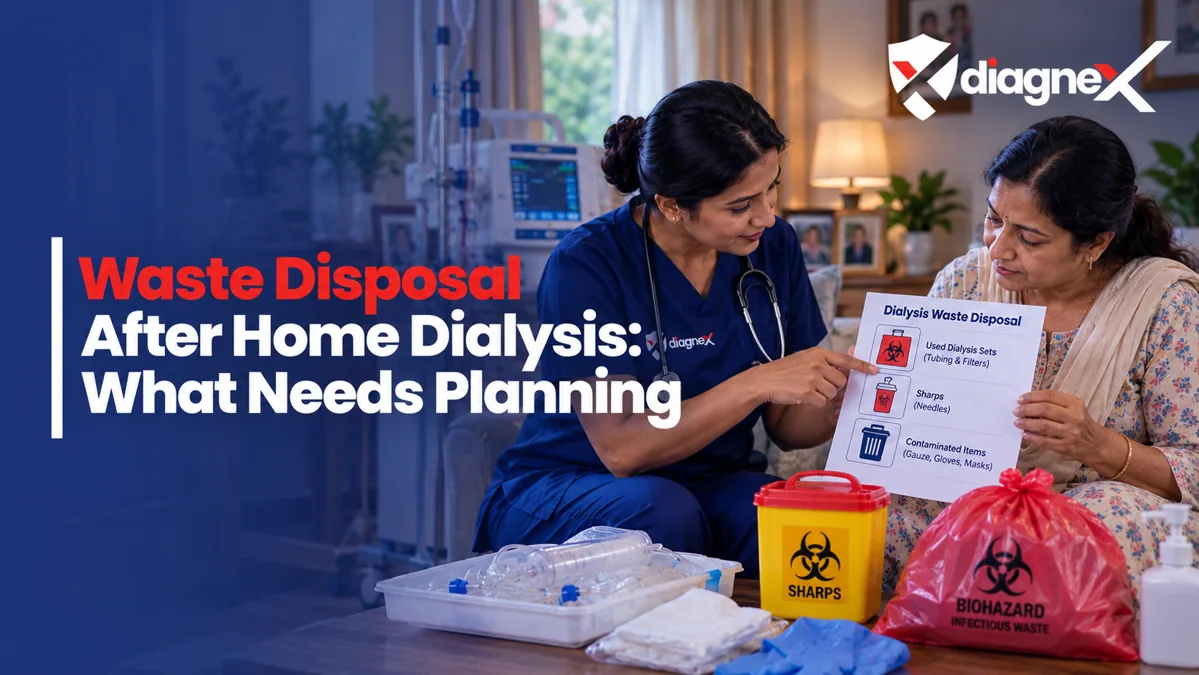
home dialysis waste disposal is an important part of planning safe home hemodialysis. Families researching dialysis waste disposal at home, home dialysis safety checklist, and dialysis supplies at home should understand how these issues connect with home dialysis setup. The exact treatment, equipment and safety process should always follow the patient's nephrology and home dialysis team.
Home dialysis waste disposal needs to be planned before the first treatment, not after the first bag of used supplies is sitting beside the machine. A home hemodialysis session can generate used bloodlines, dialyzer or cartridge components, dressings, gloves, access-related materials, sharps, packaging and liquid waste. These items do not all belong in the same bin.
The exact disposal pathway depends on the home dialysis system, the patient's vascular access, the service provider and the local biomedical-waste arrangement. Families should therefore receive a written waste-segregation and collection plan as part of home dialysis training. The safest principle is simple: separate waste at the point where it is generated, place sharps immediately into an approved sharps container, keep contaminated treatment waste away from clean stock and household recycling, and use the provider's authorised collection or disposal pathway rather than improvising.
Why Waste Planning Matters in Home Hemodialysis
Dialysis brings medical treatment into a household environment. That creates practical advantages for the patient, but it also means that waste normally handled by trained healthcare staff may now be generated in a bedroom, living area or dedicated treatment room.
Poor waste handling can expose family members, domestic workers, waste collectors and pets to used needles, blood-contaminated materials or treatment chemicals. It can also create odour, leakage and storage problems if used materials accumulate between collections. A safe home dialysis setup therefore includes not only the machine, water, electricity and supplies, but also a clear end-of-session waste routine.
What Types of Waste Can Home Dialysis Generate?
The exact mix depends on the machine and access type, but common waste categories can include: This detail should be confirmed with the home dialysis team because the exact process depends on the patient's machine, vascular access and prescription. This point is part of home dialysis waste disposal, and the exact home procedure should follow the patient's dialysis programme and selected equipment.
- Used needles or other sharps
- Bloodlines, tubing, dialyzer or disposable cartridges
- Blood-stained gauze, dressings and swabs
- Gloves and other contaminated disposable items
- Empty saline or solution containers
- Medicine vials or ampoules where relevant
- Clean cardboard and outer packaging
- Spent dialysate or machine wastewater
These categories should not automatically be managed in the same way. For home dialysis waste disposal, the safest approach is to follow the programme's training and selected equipment instructions rather than improvise at home.
Separate Waste at the Point of Generation
The easiest time to sort dialysis waste is immediately after an item is used. Once used materials are mixed together in a household bag, separating them later creates unnecessary handling and increases the risk of needlestick injury or contamination.
The home dialysis provider should show the patient or care partner which container or bag is used for each category in that specific programme. The containers should be positioned close enough to the treatment area that waste can be discarded safely without carrying exposed items through the home.
Sharps Need a Dedicated Container
Needles, lancets and other contaminated sharp objects should go directly into an approved puncture-resistant sharps container after use. They should not be left on the treatment table, recapped casually, carried around the home or placed loose into an ordinary rubbish bag.
The container should remain upright and should be placed where it can be reached safely during treatment but cannot be accessed by children or pets. In India's healthcare-waste framework, contaminated sharps are segregated into puncture-proof, leak-proof and tamper-proof containers. Home programmes should provide or specify an equivalent safe pathway and explain how the filled container is collected or handed over for authorised treatment.
Do Not Overfill the Sharps Container
A sharps container becomes harder and more dangerous to use when it is packed beyond its intended fill level. Needles can protrude, the lid may not close properly and the risk of accidental injury increases. Families should replace the container according to the fill line or provider's instructions and should know in advance who supplies the replacement.
Used Bloodlines and Dialyzers
Bloodlines, tubing and dialyzer components may contain residual blood after treatment. They should therefore follow the provider's contaminated biomedical-waste pathway rather than being treated automatically as ordinary household plastic.
Some home dialysis systems use an integrated disposable cartridge rather than separate bloodlines and dialyzer. The same principle applies: once a component has been used in the blood circuit, the family should follow the specific disposal instructions supplied for that device.
Blood-Stained Gauze, Dressings and Swabs
Dressings or gauze used around fistula needles, graft access or catheter care may be contaminated with blood. These materials need to be segregated according to the provider's biomedical-waste plan. They should not be mixed with clean household paper or recycling simply because the item itself is made of cotton, paper or plastic. For more on the practical service arrangements, review dialysis on wheels before deciding what information the care team needs.
Gloves and Other Contaminated Disposable Items
Gloves, masks or other disposable protective items used during treatment may also need to follow the contaminated-waste pathway if they have been exposed to blood or treatment fluids. The provider should distinguish between clinically contaminated items and clean packaging so the family is not unnecessarily treating every piece of household rubbish as biomedical waste.
Medicine Vials, Ampoules and Injection Waste
Some patients may receive prescribed medicines during or around dialysis. Empty medicine containers, broken glass ampoules and unused or expired medicines can have different disposal requirements from plastic dialysis tubing.
Families should not place glass ampoules loosely into ordinary waste where they can cut someone. The home dialysis programme or pharmacy should explain the approved pathway for medication-related waste.
Clean Packaging Is Different From Contaminated Treatment Waste
Dialysis supplies often arrive in cardboard boxes, plastic overwraps and individual sterile packages. Packaging that has remained clean and has not been contaminated by blood or treatment fluids may be managed differently from used clinical waste, depending on local household waste and recycling rules.
The family should keep clean outer packaging separate from contaminated treatment materials from the beginning. This avoids increasing the volume of biomedical waste unnecessarily.
Spent Dialysate and Liquid Waste
Water-based hemodialysis systems commonly discharge spent dialysate and wastewater through the approved drain connection as part of normal machine operation. Families should use only the drainage pathway installed or approved for their system.
Liquid waste should not be manually emptied into random household locations if the machine or provider specifies a particular drain route. The treatment team should explain what happens to spent dialysate, rinse water and disinfection fluids for that specific machine. If the system uses chemical disinfectants, their disposal process should follow the equipment instructions and local wastewater requirements.
What About RO Reject Water?
A reverse-osmosis system can produce reject water as part of the purification process. The installation plan should specify where that water is discharged. Families should not reroute RO reject water or other dialysis wastewater without checking with the equipment provider, because drainage requirements can depend on the machine and plumbing setup.
Do Not Mix Sharps With Soft Waste
One of the most important practical rules is to keep sharps separate from bags containing tubing, gauze or other soft waste. A needle hidden inside a flexible bag can injure the patient, caregiver, collection staff or anyone handling the bag later. Sharps should go into their dedicated rigid container immediately after use.
Do Not Put Used Needles Into Household Recycling
A needle or other sharp is not recyclable household metal simply because it is made of metal. It has a different risk profile after clinical use and must follow the approved sharps-waste pathway. Similarly, blood-contaminated tubing should not be placed into ordinary plastic recycling unless the authorised waste process specifically treats it before recycling.
Why Colour-Coded Waste Systems Need Provider Guidance
Healthcare facilities in India use colour-coded segregation under the Bio-Medical Waste Management Rules. The categories distinguish types such as contaminated recyclable waste, soiled waste, sharps and glass.
A home dialysis family should not assume that owning the same colour of bag automatically creates a compliant disposal system. The important issue is the complete pathway: segregation, safe containment, collection, transport and authorised treatment. The home dialysis provider should explain which containers are supplied for the home programme and how they connect to the authorised biomedical-waste system.
Temporary Storage Before Collection
Some waste may remain in the home until the provider or authorised collection service collects it. Temporary storage should therefore be planned carefully.
Used clinical waste should be kept in the designated closed container or bag, away from the clean supply area, food, children, pets and routine household traffic. The storage point should be protected from heat, rain, tearing, pests and accidental access. It should not become a general household dumping area.
Keep Waste Away From Clean Dialysis Supplies
A safe treatment room should have a clear separation between unopened supplies and used materials. Clean stock belongs in a dry, organised storage area, while used waste should move directly into the designated disposal container. Allowing waste bags or filled sharps containers to accumulate beside new dialyzers, dressings or cartridges increases clutter and makes contamination more likely.
What to Do if a Waste Bag Leaks
If a bag containing contaminated waste leaks, the family should follow the spill and replacement procedure taught by the provider. Disposable gloves or other protective equipment may be required.
The leaking bag should not simply be placed inside an ordinary household bag and forgotten if the provider requires a specific biomedical-waste container. The surrounding surface should be cleaned and disinfected using the approved method for the home dialysis programme.
What to Do After a Blood Spill
Blood spills should be handled using the infection-control process taught during home dialysis training. The area should be kept away from children or pets until it has been cleaned and disinfected. If the spill is large, difficult to manage or associated with active patient bleeding, contact the dialysis team and address the patient's condition first.
What if a Needle Is Dropped?
A dropped used needle should not be picked up casually by hand. Follow the sharps-handling process taught by the provider and place it into the approved sharps container without unnecessary handling. If someone is accidentally stuck by a used needle, wash the area as instructed and seek prompt medical advice through the provider's exposure pathway.
Needlestick Injuries Need a Plan
Home dialysis training should include what to do after an accidental sharps injury. Families should know whom to call, where to obtain medical assessment and how the incident should be reported. This is especially important when more than one person is involved in treatment, such as a trained care partner, nurse or technician.
Can Waste Be Stored Until the Next Collection?
The provider should define the collection frequency and maximum storage arrangement for the home programme. Families should not allow bags of contaminated treatment waste to accumulate indefinitely. If collection is delayed, the family should contact the provider rather than moving biomedical waste into ordinary household disposal without guidance.
Who Collects Home Dialysis Waste?
The answer depends on the service model. In some programmes, the dialysis provider coordinates biomedical-waste collection. In others, the household may be linked to an authorised waste-management service or given a defined handover process. If the family is considering support at home, the Diagnex guide to home nursing explains the service pathway and its limits.
This responsibility should be clarified before home treatment begins. A family should not discover after the first session that nobody has arranged collection.
What the Provider Should Explain Before Treatment Starts
The home dialysis provider should explain: This is also part of routine home dialysis safety, so any uncertainty should be clarified with the treating or home dialysis team before the next treatment. This point is part of home dialysis waste disposal, and the exact home procedure should follow the patient's dialysis programme and selected equipment.
- Which items are considered sharps
- Which used materials are treated as contaminated biomedical waste
- Which clean packaging can follow ordinary household waste or recycling rules
- How liquid waste is discharged
- Which containers and bags are supplied
- How often waste is collected
- Who collects it
- What to do if a container is full before collection
- What to do after a spill or needlestick injury
Waste Planning in Apartments
Apartment living can make waste storage and collection more complicated because the family shares lifts, corridors and common waste areas with other residents. Biomedical waste should not be left in a common corridor, building lobby or ordinary shared garbage room unless that is specifically part of an authorised collection pathway. The provider should plan how sealed waste containers move from the treatment area to the collection point without creating unnecessary exposure to neighbours or building staff.
Waste Planning in Homes With Children or Pets
Homes with children or pets need additional attention to where used waste is kept. A sharps container should not be accessible from the floor, and soft waste bags should not be left where they can be torn open. A closed cupboard, utility area or another secure location may be appropriate depending on the collection system and household layout.
Waste Planning for a Caregiver-Run Session
If a trained family caregiver helps with dialysis, both the patient and caregiver should follow the same waste-segregation routine. Waste handling should not depend on who happened to be present that day. A written checklist can make the end-of-session process consistent and reduce confusion.
Waste Planning When a Nurse or Technician Attends
When professional staff attend the home session, families should clarify whether the visiting service removes the biomedical waste or leaves it in the household's approved collection containers. The presence of a nurse or technician should not create ambiguity about who is responsible after the session.
What Happens to Used Dialysis Waste After Collection?
Once collected through an authorised biomedical-waste pathway, different waste streams may undergo different treatment processes. Sharps, contaminated plastics, soiled waste and glass are not necessarily treated in the same way.
Families do not need to manage the downstream treatment process themselves. Their responsibility is to segregate and contain the waste correctly so the authorised system can handle it safely.
Why Ordinary Household Bins Are Not a Complete Plan
A household dustbin is designed for normal domestic waste. It is not designed to protect waste workers from exposed dialysis needles or to identify blood-contaminated medical plastics. The provider should explicitly tell the family what, if anything, can enter ordinary household waste and what must remain in the biomedical-waste stream.
What About Empty Cardboard Boxes?
Clean cardboard cartons that never contact blood or clinical waste may often be managed as ordinary household packaging under local rules. They should be flattened or recycled only if they remain clean and the local system accepts them. If a carton becomes contaminated by blood, leaking treatment fluid or clinical waste, the provider should advise how it should be handled.
What About Empty Plastic Wrappers?
Clean outer plastic packaging may be different from blood-contaminated medical plastic. The key distinction is whether the item was part of the contaminated treatment pathway. Families should follow local household waste rules for genuinely clean packaging and the provider's biomedical-waste instructions for contaminated items.
What About Unused but Expired Supplies?
Expired dialysis supplies should be separated from usable stock and handled according to the provider's return or disposal process. They should not be opened or used simply to avoid waste. Medicines may have a different return or disposal pathway from sterile consumables, so the family should not assume they are handled the same way.
What About Broken Glass?
Broken ampoules or contaminated glass can cause cuts and should not be placed loose in a flexible waste bag. Use the container specified by the provider or authorised biomedical-waste plan. Families should not reach into a waste bag to retrieve broken glass after it has been discarded.
What About Unused Needles?
Unused sterile needles that remain sealed and within expiry are not the same as used sharps. They should remain with clean stock until needed. If an unused needle becomes unsterile, damaged or expired, the provider should explain the correct disposal pathway rather than the family simply placing it into household waste.
What About Dialysis Machine Cleaning Chemicals?
Machine disinfection products can have specific handling and disposal instructions. A family should not pour unused chemical concentrate into a sink or toilet unless the equipment instructions and provider explicitly permit that route. Follow the product label and the home dialysis programme for storage, dilution, use and disposal.
Personal Protective Equipment During Waste Handling
Waste handling may require gloves or other protective equipment depending on the task. The home dialysis programme should teach when gloves are needed and how to remove them without contaminating clean surfaces.
Gloves do not replace hand hygiene. Hands should be cleaned according to the provider's infection-control process after handling used treatment materials.
A Safe End-of-Session Waste Routine
A simple routine helps prevent waste from accumulating around the dialysis machine. After treatment, the patient or care partner may follow a sequence such as:
- Place sharps directly into the approved sharps container
- Place contaminated tubing, dialyzer or cartridge into the designated waste container
- Place blood-stained dressings and related waste into the specified bag or container
- Keep clean packaging separate
- Complete the machine's approved drainage and cleaning process
- Seal or close waste containers as instructed
- Move used waste to the designated secure temporary-storage point
- Clean the preparation area and perform hand hygiene
The exact sequence should match the home dialysis programme rather than this generic framework. This detail should be confirmed with the home dialysis team because the exact process depends on the patient's machine, vascular access and prescription.
Home Dialysis Waste Disposal Checklist
Before routine home treatment begins, families should be able to confirm that: For home dialysis waste disposal, the safest approach is to follow the programme's training and selected equipment instructions rather than improvise at home. This point is part of home dialysis waste disposal, and the exact home procedure should follow the patient's dialysis programme and selected equipment.
- A sharps container is available
- Contaminated waste bags or containers are available
- Clean household packaging has a separate pathway
- Liquid waste drainage is understood
- Temporary storage is secure
- Children and pets cannot access used waste
- Collection frequency is clear
- A collection or handover service has been identified
- Spill and needlestick procedures are known
- Backup instructions exist if collection is delayed
Common Mistakes to Avoid
Common avoidable mistakes include putting needles into soft bags, mixing clean packaging with blood-contaminated waste, overfilling sharps containers, leaving waste beside clean supplies and assuming that every used item can go into the household bin. Another mistake is buying colour-coded bags without understanding who will legally collect and process them. Safe waste management depends on the complete pathway, not just the colour of the container. For care planning beyond this article, compare kidney care with the instructions already given by the treating professional.
The Bottom Line
Waste disposal after home dialysis needs the same level of planning as storage, electricity and water. The household should know what becomes a sharp, what counts as contaminated clinical waste, what remains ordinary clean packaging, where liquid waste drains and how the biomedical waste leaves the home.
Sharps should go directly into an approved puncture-resistant container. Blood-contaminated tubing, dialyzer or cartridge components, dressings and similar used materials should follow the provider's biomedical-waste pathway. Clean packaging should be kept separate, and machine wastewater should follow the approved drainage arrangement.
The family should not have to invent a disposal system. A safe home dialysis programme should provide the containers, training, collection instructions and escalation pathway needed to manage waste without exposing household members or waste handlers.
Frequently Asked Questions
Can home dialysis needles go into the household bin?
No. Used needles and other sharps should go directly into an approved sharps container and follow the provider's authorised biomedical-waste disposal pathway.
What should I do with used bloodlines and a dialyzer?
Follow the home dialysis provider's contaminated-waste instructions. Used bloodlines and dialyzer or cartridge components may contain residual blood and should not automatically be placed in household recycling.
Can clean dialysis packaging go into normal recycling?
Clean outer cardboard or packaging may be managed under local household waste or recycling rules if it has not been contaminated. Keep it separate from used clinical waste and confirm local requirements.
How should sharps be stored before collection?
Keep them in the approved closed, puncture-resistant sharps container, upright and secure from children or pets. Do not transfer loose sharps into another bag.
What happens to spent dialysate at home?
In many water-based home hemodialysis systems, spent dialysate and wastewater are discharged through the approved drain connection. Follow the machine installation and provider instructions for the exact setup.
Can I keep biomedical waste until the provider collects it?
Only within the temporary-storage arrangement defined by the home dialysis programme. Used waste should remain sealed or contained, secure and separate from clean supplies while awaiting authorised collection.
What should I do if a sharps container fills up early?
Do not overfill it. Close it according to the instructions and contact the provider for a replacement and collection guidance.
Who is responsible for arranging home dialysis waste collection?
That depends on the service model, but responsibility should be agreed before home treatment begins. Ask the provider exactly who collects the waste, how often and what to do if a scheduled collection is delayed.
This point should be confirmed with the home dialysis team because the exact process can vary by patient, machine and programme..
Related Diagnex guides
Explore Home Dialysis services, other Home Dialysis guides and Water Supply Failure During Home Dialysis: What to Plan For.
Diagnex publishes general healthcare information to support care planning. Individual decisions about diagnosis, prescriptions and treatment remain with the treating professional. Read our medical content policy and editorial standards.


